Showing posts with label Camp Chase. Show all posts

Tuesday, February 19, 2008

ON THIS DAY: Thursday, Feb. 20, 1862

Itching for battle

Generals Grant, McClernand, and Wallace spend the day visiting Clarksville, Tennessee, which General Smith’s division has just occupied on Grant's behalf. This widens the notch Union forces have carved in northwestern Tenessee with the Forts Henry and Donelson campaign.

Clarksville, McClernand wrote his wife, is a “beautiful village or town of 5 or 6000 inhabitants,” but almost completely deserted by its white residents. “We marched through the streets but met no welcome except from the negros,” the general wrote.

Clarksville is strategically located on the Cumberland River, part-way between Fort Donelson and Nashville, the Tennessee capital. Confederate forces have withdrawn from Nashville, so Foote’s gunboats and Grant’s infantry could easily capture the city—if Maj. Gen. Henry W. Halleck, Grant’s superior, hadn’t forbidden it. Now Grant is forced to sit still and think about what he might do next.

ELSEWHERE IN THE CIVIL WAR: The 48th Ohio, which had spent months waiting impatiently at Camp Chase while it slowly filled its ranks, has finally been ordered into the war zone and today arrives in Paducah, Kentucky. The 48th had traveled from Cincinnati by steamboat, an overnight trip. The regiment will remain in Paducah for more than two weeks, most of the time training without weapons—a source of great dissatisfaction for the men. They want to see action. After the war, a regimental historian will write, “The general opinion of the rank and file seemed to be, ‘The war will be over before we can get into it.’ Alas! How little any of us dreamed of what was to come.”

IT’S COMING SOONER THAN YOU THINK: April 12, 2011—less than 3½ years from now!—will be the 150th anniversary of the outbreak of the Civil War. In 1861, April 12 was the day Confederates opened fire on Fort Sumter in Charleston Harbor.

Your suggestions, comments, and questions about this blog are always welcome. Address the author: Ohioan@bloodtearsandglory.com

For more information about the author and his newest book, please go to
http://www.orangefrazer.com/btg

Monday, February 18, 2008

ON THIS DAY: Tuesday, Feb. 18, 1862

The guns “cracked as fast as popcorn”

Pvt. Andrew Altman, a farm boy from Henry County, Ohio, and a member of the 68th Ohio, has been having the time of his life in the army, compared with what must have been a threadbare existence on a small farm in northwestern Ohio. At Camp Chase in Columbus, he reveled in the abundant food and ample clothing provided by the army. And then there was the excitement of going to war for his country and the possibility of “shootin’ a rebel.”

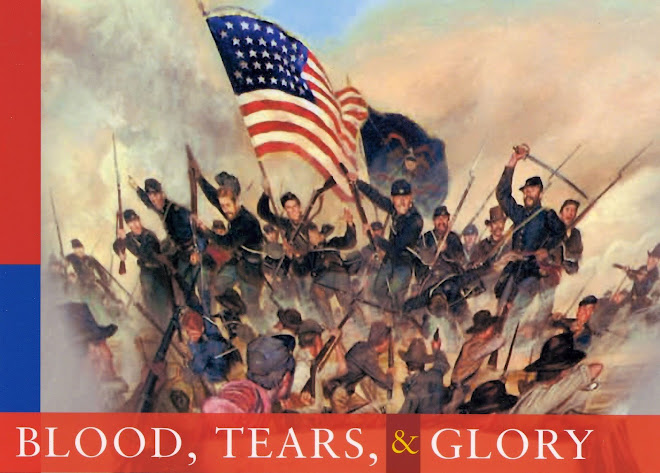
A few days ago,, the 68th had been rushed from Camp Chase to Halleck’s Western Department and now Altman and his regiment find themselves at Fort Donelson, if only in a support role. The 68th sees no action in this battle and takes no casualties, but, writing home today and four days later, Altman reports he had a front-row seat from which to view the battle (Pictured above.). “We were in sight all the time and the canon ball came torde us and some of the boys dug it out of the ground. There is dead men a laying a round here yet over the ground.”

Ohio is amply represented Fort Donelson by its son, Brig. Gen.Ulysses S. Grant, but of the estimated 24,090 Union infantrymen present, only about 2,190 are Ohioans, distributed among four regiments. (Most of Grant’s army comes from Illinois.) Of the battle’s approximately 2,600 casualties (killed, wounded, or missing), only 19 are Ohioans. Ohio’s sacrifice will soon enough, however.

In the meantime, Ohioans like Altman are excitedly writing to tell their families what they saw. “The 58th [Ohio regiment] charged bayonets on [the Confederates] and you ought to a seen them run over the [breastworks]. They went like deer,” wrote a proud Altman.

Four days later, he wrote his father, “I would liked if you had been here when the fight commenced. The guns cracked gust as fast as though you would put pop corn in [the] ovin.” Having had time to ponder what he has seen, Altman now mixes a bit of bravado with stoicism. “Oh if I ever get home, I would feel like going a gain. If it is my lot to be shot, so it be and if not so mutch the better.”

Elsewhere in the vicinity of Fort Donelson, General Grant continues with the tedious follow-up work of battle. Perhaps the most dramatic incident of the day occurs when some Union soldiers gather around the jail in the nearby town of Dover, angry over what looks, at first glance, as if several of their fellows had been bound and gagged, then shot. The rumor spreads throughout the area, gathering so much force that it alarms Confederate General Simon B. Buckner. He quickly sends a message to General Grant, warning that fears are mounting that angry Union soldiers are threatening revenge to their Confederate prisoners.

The situation at the jail is investigated quickly. It clearly appears that the four bodies there were NOT tied and, in fact, had been laid out for burial. They were fully clothed, their wounds bandaged, and showed no signs of abuse. They simply were combat fatalities whose fellow soldiers had placed the bodies in the jail to shelter them. End of story.

IT’S COMING SOONER THAN YOU THINK: April 12, 2011—less than 3½ years from now!—will be the 150th anniversary of the outbreak of the Civil War. In 1861, April 12 was the day Confederates opened fire on Fort Sumter in Charleston Harbor.

Your suggestions, comments, and questions about this blog are always welcome. Address the author: Ohioan@bloodtearsandglory.com

For more information about the author and his newest book, please go to
http://www.orangefrazer.com/btg

Thursday, December 20, 2007

ON THIS DAY: Thursday, Dec. 19, 1861


“The Contrabands”

Sometimes they creep furtively out of the woods and sometimes they walk boldly down the road; sometimes they come in groups and sometimes singly; but they all have the hunted look of men and women trying to get away from something.

They are runaway slaves, and the men in the Union army have a word for them: “contrabands.”

Despite Southerners’ claims of how well they treat slaves, slaves have been escaping northward for decades. Within weeks after the fall of Fort Sumter, they began showing up at the Virginia military base of Union Maj. Gen. Benjamin F. Butler.

Butler put the escapees to work. He called them “contrabands,” because they had been assets to the Confederates and therefore subject to confiscation under the rules of war. But in these early days of the war the Lincoln administration is treading lightly on the issue of slavery and putting national reunion as its first priority. By degrees, Lincoln and the Congress begin freeing slaves, but until after the war emancipation will be a “work in progress,” rife with ambiguity.

Escaped slaves are showing up at many Union army camps, where they get differing welcomes. Sometimes Union officers return slaves to their owners, trying to dampen secessionism. Many other officers, however, are unable to stomach slavery and harbor the runaways.

Lt. Col. Rutherford B. Hayes is one of these, and as escapees come into the camp of the 23rd Ohio in Fayetteville, western Virginia, he does his best to accommodate them until they can be sent westward to Ohio. “Quite a number have come to me,” Hayes writes Uncle Sardis Birchard in Fremont, Ohio. He urges his uncle to accept a family that he is directing to Fremont. “Allen…will do for a house servant….His wife can cook. If you don’t want them, you can safely recommend them…these are the pick of the lot.”

With slightly less than full confidence in what he is doing, Hayes opines that the family is “entitled to freedom, as I understand the rule adopted by our government. The rule is, I believe that slaves coming to our lines, especially if owned by Rebels, are free.” Hayes is probably referring to the “Confiscation Act” passed by Congress on August 6, the first in a series of steps freeing certain slaves that will lead to Lincoln’s Emancipation Proclamation of January 1, 1863.

ELSWHERE: Apart from a skirmish in Maryland—no casualties reported—all, is quiet on the front lines. In Cairo, Illinois, Brig. Gen. Ulysses S. Grant fires of a flurry of short, crisp dispatches on routine matters. St. Louis, Brig. Gen. William Tecumseh Sherman wonders what will become of him, now that he has returned to duty after his “rest break.” In Ohio, recruits drill at Camp Chase in Columbus and Camp Dennison, near Cincinnati, waiting for their regiments to fill and worrying that the war will be over before they can see some action.