Showing posts with label 53rd Ohio. Show all posts

Sunday, April 6, 2008

ON THIS DAY: Sunday, April 6, 1862


"The Devil’s Own Day”

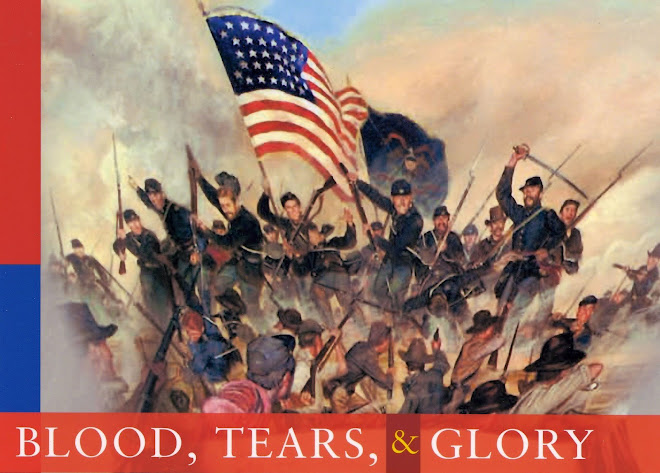
(The following is condensed from Blood, Tears, and Glory: How Ohioans Won the Civil War, by James Bissland; published in 2007 by Orange Frazer Press., Inc.)

Early this morning, 1st Lt. Marion Posegate of the 48th Ohio is enjoying his first cup of coffee and “the soft, shimmering opening of a typical Southern spring day” when suddenly he hears the rolling thunder of a drummer’s alarm and scattered gunshots.

Posegate—who is acting adjutant of the 48th—buckles on his sword, but before he can finish ordering the regiment into a defensive line of battle, the impetuous colonel of the 48th, a Cincinnati lawyer named Peter J. Sullivan, rushes up and orders the men forward, towards the sound of gunshots.

But the men soon encounter an oncoming rush of Confederates and rush back to their original position. They fire one unified volley standing up and then wisely take cover behind trees and fallen trunks, firing carefully and at will.

The 48th Ohio is one of Sherman’s regiments, camped along and a ridge, with the crude log hut known as the Shiloh Meetinghouse its centerpiece. From his place on the ridge, 1st Lt. Ephraim C. Dawes of the 53rd Ohio views a scene that is “one never to be forgotten.” Sherman’s division is forming a ragged line of battle, but it has gaps in it because so many men are absent because of sickness. Behind the line of battle, teamsters, servants, and frightened soldiers are fleeing in the direction of the Tennessee River. Directly in front of Dawes are solid ranks of Confederates, their bayonets and swords gleaming in the early morning sun. They are advancing four ranks deep on a three-mile front, with one rank after another rolling forward like the tide.

Some Union regiments break and run for the shelter of a bluff by the river; others, though depleted by runaways, stand their ground until they can resist no longer and are forced to retreat, still fighting. This goes on all day, thousands of men running away, but more thousands putting up a stout defense even as they backpedal. Galloping furiously back and forth, directing the troops, are Maj. Gen. Ulysses S. Grant and Brig. Gen. William Tecumseh Sherman. They had failed to prepare for or even consider the possibility of the Confederate attack, but now they are working fearlessly and furiously to rally their stunned forces.

Enemy fire is so heavy, according to Posegate, that thickets of brush look as if they have been cut down with “a dull sickle.” Trees are riddled with bullets and branches broken; only the fact that the inexperienced Confederates fire too high—as new soldiers often do—saves the 48th from annihilation. Posegate is wounded and removed a hospital boat.

By evening, the Union forces are pushed back almost to the Tennessee River, but they still hold Pittsburg Landing. Artillery and a deep ravine protect Grant’s army from destruction and so—unintentionally—does Confederate Gen. P.G.T. Beauregard, who took command after Maj. Gen. Albert Sidney Johnston was mortally wounded. Certain he can finish off the Federals tomorrow, Beauregard calls off the attack at 6 p.m, wires Richmond that he has attained “a complete victory,” and goes to sleep in Sherman’s abandoned tent.

With thousands of Union soldiers huddled in fear beneath a bluff while thousands more cling to a sliver of land near the river’s edge, Sherman says to his commander, “Well, Grant, we’ve had the devil’s own day, haven’t we?” Quietly puffing his customary cigar, Grant calmly replies, “Yes, lick ‘em tomorrow, though.”

That calm optimism in the face of discouragement will become Grant’s hallmark and, in Sherman’s opinion, the explanation for his greatness.

IT’S COMING SOONER THAN YOU THINK: April 12, 2011—scarcely 3 years from now!—will be the 150th anniversary of the outbreak of the Civil War. In 1861, April 12 was the day Confederates opened fire on Fort Sumter in Charleston Harbor.

Your suggestions, comments, and questions about this blog are always welcome. Address the author: Ohioan@bloodtearsandglory.com

For more information about the author and his newest book, please go to
http://www.orangefrazer.com/btg

Saturday, April 5, 2008

ON THIS DAY, Saturday, April 5, 1862


Shiloh: The Day Before

Late in day, Confederate Maj. Gen. Albert Sidney Johnston’s Army of Mississippi, numbering 45,000 men, arrives at the launch point designated for their attack on Grant’s encampment. As they settle down for the night, they are, in places, only half a mile from the outer edges of the Union Army of the Tennessee at Pittsburg Landing. (Johnston is pictured here)

Johnston’s second-in-command, Maj. Gen. P.G.T. Beauregard, is in despair. “The Little Creole,” as the fiery officer is nicknamed, is not one to shrink from fighting, but he fears the element of surprise has been lost. The inexperienced Confederate soldiers have taken two days longer than expected to make the march and they made it noisily, carelessly yelling and firing off their guns to try them out. Soldiers on the outer edges of each army have clashed several times, both sides taking small numbers of casualties.

Surely, Grant must be ready and waiting for Johnston.

But he isn’t.

Speculation that something is looming has been rising among the Union rank-and-file. Several Confederate prisoners have bragged to their captors that an attack is coming. One, dying from his wounds, has warned, “More will die.”

The commander of the 53rd Ohio, Col. Jesse J. Appler, orders his regiment into line of battle after he learns some scouts have been fired on by a Confederate picket line. When he tries to warn his division commander, Brig. Gen. William Tecumseh Sherman, Sherman snaps back, “Take your damned regiment to Ohio. There is no enemy nearer than Corinth:”

So nervous in Kentucky (and, later, Missouri) about the possibility of enemy attack, Sherman now has completely reversed himself, refusing to acknowledge whatsoever any sign of danger.

This afternoon, Sherman sends a message to Grant at Savannah, who is waiting for Brig. Gen. Don Carlos Buell’s reinforcements to arrive. Although Sherman provides some information about yesterday’s skirmishes between forward units, he concludes that the enemy is only being “saucy.” He concludes, “I do not apprehend anything like an attack on our position.”

Sherman’s opinion counts, because his division, now counting about 8,500 men “present for duty,” occupies the Union encampment’s most forward position, about two miles inland from the Tennessee River. Four other divisions are scattered about the rolling plateau and a fifth, Lew Wallace’s, is stationed several miles away.

Because Grant’s mind is fixed on making his own attack on the Confederates, who ordinarily would be expected to remain in Corinth, protected by their earthworks, Grant has ordered no earthworks of his own. His 41,000 troops at Pittsburg Landing are scattered about, arranged more for convenience than defense.

From his headquarters at Savannah, a few miles downriver from Pittsburg Landing, Grants wires two messages to his superior, Maj. Gen. Henry W. Halleck in St. Louis. In the first, he asserts that “the main force of the enemy is at Corinth” and their number “cannot be far from 80,000 men.” In the second, Grant mentions yesterday’s clashes, but concludes, “I have scarcely the faintest idea of an attack (general one) being made upon us but will be prepared should such a thing take place.”

At almost the same time as Grant is reassuring Halleck, the Confederate generals are gathered around a fire only a few miles from Pittsburg Landing. They are pondering their options. Beauregard argues for cancelling the attack and returning to Corinth, fearing a “victory turned into defeat” by an alert Union army. But Johnston—who is suffering public scorn for withdrawing from Nashville—apparently feels he cannot afford another seeming sign of weakness. The attack will go forward in the morning. Their horses will drink from the Tennessee River.

As the weary soldiers try to rest, some of them can hear a distant band playing. It is a Union band and it is playing “Home Sweet Home.”

IT’S COMING SOONER THAN YOU THINK: April 12, 2011—scarcely 3 years from now!—will be the 150th anniversary of the outbreak of the Civil War. In 1861, April 12 was the day Confederates opened fire on Fort Sumter in Charleston Harbor.

Your suggestions, comments, and questions about this blog are always welcome. Address the author: Ohioan@bloodtearsandglory.com

For more information about the author and his newest book, please go to
http://www.orangefrazer.com/btg